Thursday, May 16, 2013

Knife Music: Good Book, Problem Reader

I remember, many years ago, that the NY Times had a film critic who seemed to love everything she saw. She was very enthusiastic, but I couldn't trust her in the end. She just liked being at the movies and watching whatever was on the screen -- and she made little distinction between a middling film and something really outstanding.

At times, I feel like a reader (and filmgoer) with the opposite problem -- little grabs or excites me. I start books and don't finish them. I'm lukewarm about movies that others rave about. It's a problem, then, if I want to offer my views with a good semblance of fairness. (When I was younger and brash, I might've argued for critical "objectivity," but not anymore.)

All of which brings me to David Carnoy's Knife Music. This is a good, entertaining book -- certainly worth noticing; I sucked it down in just a few days. It's the story of hotshot, semi-womanizing ER surgeon Ted Cogan who is (wrongly?) accused of the statutory rape (which is just plain rape in California) of a teenage patient. Cogan is a complex character, sympathetic yet cold, well-off and resourceful but in deep trouble. He's pitted, in part, against a dedicated police detective, Hank Madden.

While I semi-feverishly turned the pages of Knife Music, it also lagged in a few areas. First, too much backstory -- especially a chapter about Cogen. And too much detail. I'm on thinner ice here. The mystery writer needs a certain amount of detail to bury clues, and detail creates "l'effet de reel" (to fall back on my weak Roland Barthes). But when is extra detail too much? Consider, for instance, that Madden spies on Cogan "through a set of compact but powerful Nikon binoculars." I would've settled for "compact" and assumed that the cop had a good enough pair of binoculars for his job; I didn't need the brand. The book seems too full of this minutia. But maybe this is just me being cranky?

Though Cogan faces the prospect of an ugly, public trial and jail, he never seems in too much jeopardy. The book is set in the wealthy environs of Silicon Valley, with jaunts to the Stanford campus, a gated community, and a country club -- wealthy but not Sternwood-wealthy. Is there some sourness to this world of privilege, something that might be exposed? Carnoy succeeds with an engaging breezy novel. Should I fault him because I wanted rougher weather?

Friday, April 12, 2013

News Flash: Bear Serves in World War II

I missed a month, but I'm back. My reading is varying widely, and though I swore off war books after reading We Wish to Inform You that Tomorrow We Will Be Killed with Our Families, I made an immediate exception for Soldier Bear by Bibi Dumon Tak, which I read for my younger daughter's library book group.

Soldier Bear is a young reader's novel based on the true story of a Syrian brown bear adopted by a group of Polish soldiers during World War II. Wojtek (or "Voytek," as the bear is called in the English translation from the Dutch) is a cute nuisance, but he eventually wins over various officers and even helps carry artillery shells. The bear accompanies the soldiers (aligned with British forces) from Egypt to Italy, where he serves near the front in a transportation company.

A central critical question seemed to hover over my reading of this book: "How do you write a book about war for young kids?" While earnest and heartfelt, Soldier Bear offers only a few tough insights into the war. One soldier, Lolek, is traumatized when he sees two soldiers killed by a bomb, but this is the only human death we see (there are other animals, too). In the end--and perhaps justifiably, considering the intended audience--Soldier Bear is more of an animal yarn than a war novel. It made me think of the animal books of Gerald Durrell (which I really don't remember, so the comparison might be off). The book also never quite emotionally captures the daily grind, boredom, and fear that fill out a soldier's everyday life. In some regards, the characters and the storytelling are a little flat.

My older daughter--a junior in high school--is in a Vietnam War class, and they are reading Tim O'Brien, Ron Kovic, and others. Though war reading can be tough, it makes sense since these students are on the cusp of enlistment/selective service age--and will soon by voters. Even younger students read All Quiet on The Western Front, which might be misguided. It's a terrifying, vivid book--no Soldier Bear--and shouldn't be relegated to high school freshmen English. (I'll note too in passing that in my post on All Quiet, I wrote, "I'm going to try to wind down my war reading for a bit," and that was in November 2010. Now, I'm really going to try--maybe I'll switch to books about urban blight, poverty, and general misery.)

Wednesday, February 27, 2013

Required Reading: We Wish to Inform You that Tomorrow We Will Be Killed

For a few years now, usually in winter, I’ve been reading books about war—novels and sometimes non-fiction. I’m not exactly sure why. In the most basic way, war books have exciting narratives—they are about life and death. War also instigates astounding actions and reactions, which make for interesting reading. I have mostly read books about Vietnam and World War II, but also Iraq and Bosnia.

Now, in what feels like a culmination and maybe a stopping point for a while, I’ve read Philip Gourevitch’s We Wish to Inform You that Tomorrow We Will Be Killed with Our Families: Stories from Rwanda (1998). It has shaken me, and in its way, shamed me. For World War II and Vietnam, I can assume the role of an historic observer. I remained more or less informed on and voted with a mind toward policy in Iraq and Afghanistan. But I think I ignored the events in Rwanda as they were happening and being reported.  During the genocide in Rwanda, I believe I was teaching an introductory course on epic, working on my doctoral dissertation, riding my bike, and generally lazing about. I neglected the pious Hebrew school adage about genocide—“Never again.” I didn’t even muster much awareness.

We Wish (I’ll use this shortened title) surely indicts my neglect. But certain actions—well-intentioned humanitarian actions—were worse than neglect in that they ended up aiding and abetting the genocidaires (the French term used for the Rwandan mass killers). It turns out, too, that the U.S. utterly neglected its obligations under UN General Assembly Resolution 260, the Convention on the Prevention and Punishment of the Crime of Genocide. Clinton expressed regret that he had not intervened (and he was the first western leader to visit Rwanda after the genocide). Gourevitch writes that then-U.S. Ambassador to the UN Madeleine Albright’s “ducking and pressuring others to duck [intervention], as the death toll leapt from thousands to tens of thousands to hundreds of thousands, was the absolute low point in her career as a stateswoman.”

If American inaction is retrospectively reprehensible, then French support for Hutu Power is even worse. Belgian colonialism played a fundamental role in creating an environment for genocide. Many religious organizations and their leaders, at least within Rwanda, supported the genocide as well.

The UN was awful. The Canadian head of the UN force, Romeo Dallaire, was repeatedly thwarted in his effort to intervene more forcefully. Though the UN prevented the massacre of some people, Dallaire later asserted that 5,000 well-equipped soldiers may have been able to prevent a half million murders.

I think I might’ve held the common misperception that the genocide was a sort of uncontrolled spontaneous mob spasm of racial killing. Chaos in a failed African state. From this point of view, it is easy to think that military and political intervention would have been futile. In fact, Rwanda was a well-organized country with a government that planned the killing well in advance, promoted it on radio and in print, and enforced its execution. Consider this: in the months leading up to the genocide, the government imported machetes from China and distributed them to the majority Hutu population for the express purpose of exterminating the Tutsi minority. In 100 days, 800,000 to a million people were killed.

Dessicated bodies at the Murambi Genocide Memorial Centre
The genocide ran its course—and civil and social order basically broke down. It ended when much of the killing had been completed and a force of primarily Tutsi exiles from Uganda drove Hutu Power out of the capital city of Kigali. This led to the formation of enormous refugee camps that sheltered war criminals along with genuine refugees. Cholera killed another thirty or forty thousand people in the camps.

Recovery in Rwanda, in Gourevitch’s account, is at least buoyed by compassionate and sensible leadership, embodied by then-General Paul Kagame (who has been Rwanda’s President since 2000). Gourevitch describes Kagame as part of a post-postcolonial era that views the west with healthy skepticism.

Late last year, I heard a presentation by Doctors Without Borders (Medicines Sans Frontieres or MSF), and its representatives spoke about the dangers of aid being used as a weapon of war. In Rwanda and cross-border refugee camps, this was certainly the case. Thus certain types of humanitarian aid are counterproductive—an argument that writer (and onetime Ugandan resident) Paul Theroux also makes in Dark Star Safari (which I reviewed back in 2002). So where does that leave a concerned westerner? I don’t know.

Thursday, January 31, 2013

Joe Sacco: Comics Journalism and Conflict

For a few weeks now, I have been reading (and viewing) the award-winning comics journalism of Joe Sacco. It has really made a strong and unexpected impact on me.

I started with Sacco's recent work in Days of Destruction, Days of Revolt, which is primarily made up of text written by Chris Hedges (discussed in my previous post). I like Sacco's work in this book, but Hedges's text plays the starring role.

In Sacco's most acclaimed books (and all his own), Palestine and Safe Area Gorazde, all the text is provided in comics panels. The images convey as much meaning and drama and reportage as the words. Unlike traditional journalism, Sacco is part of the story: his thin, worried figure makes its way through muddy streets in war-torn Bosnia (1992-95) or the West Bank or Gaza Strip (from 1990-91). We see him as outsider impacting the story -- and he also stands in for us -- amazed and befuddled at the destruction and survival of the places he visits.

I'm not a comics or graphic novel aficionado, but I would say that Sacco's drawings are loosely in an R. Crumb style, but a little more realistic (in his later works) and finely detailed. Sacco's birds-eye panoramas are especially compelling, showing wide angles and bustling activity that aren't usually caught in a photograph. Perhaps an apt comparison would be Brueghel. To my mind, the tension between the subject matter -- serious and deadly -- and the comics style gives the work great vitality.

Sacco mostly focuses on the nature of civilian life in conflict-torn areas. He also provides some history and context, especially in Gorazde. The U.N. comes off very poorly.

Sacco doesn't have a website, though you can find some images online. It's far better to dive into the over-sized books. I've included a couple of covers and one author self-drawing (much like what appears in his books; taken from the publisher Drawn & Quarterly's website). I believe this constitutes fair use, but I want to respect copyright, so if image owners (e.g., Sacco, his publishers) want images removed, please say so in the comments.

Monday, December 31, 2012

War and Sacrifice Zones

I ended the year reading two really interesting, deeply troubling books: Dexter Filkins's The Forever War; and Chris Hedges and Joe Sacco's Days of Destruction, Days of Revolt. Though the books have no direct ties, together they make a provocative pair. Both -- but especially DDDR -- are critical of American ideology, policies, and conduct. Hedges and Sacco are forthright in calling for citizen revolt, through nonviolent disobedience.

Filkins's book snuck up on me. Published in 2008, it covers primarily combat and sectarian violence in Iraq following the invasion. It is not, however, a history or a piece of straight-up journalism (Filkins was a reporter for the LA Times and then the New York Times). Instead, it mixes reporting with personal narrative -- the weirdness and disjointedness of the places and the war are reflected by Filkins's telling.

The first part of the book recounts some of Filkins's experiences in Taliban-controlled Afghanistan before 9/11. In a soccer stadium in Kabul, Filkins witnessed the amputation of a man's hand (for theft), and the execution of another man (for murder/manslaughter). The Taliban were warily accepted by people in Afghanistan because they brought some social stability and security to a fragmented country (headed towards the anarchy of Somalia). In Filkins's reckoning, the future of Afghanistan will be either bad or worse.

Filkins's take on Iraq is slightly more hopeful, but not by a lot. Rather than drawing broad conclusions, Filkins primarily recounts his experiences and lets them speak for themselves. Though the U.S. has obvious combat superiority -- and Filkins describes Falluja at its worst -- it has limited political and diplomatic capabilities. The U.S. was never going to be able to transform the country working from the isolation of the heavily fortified Green Zone in Baghdad.

Filkins, to a certain extent, followed in Hedges's footsteps. Hedges was also a New York Times war correspondent. He covered wars in Latin America, reported from inside the siege of Sarajevo, and wrote from several other war zones. Earlier this year, I read Hedges's philosophical distillation from all his war reporting, War Is A Force That Gives Us Meaning (2002). Hedges essentially lost his Times job for publicly opposing the invasion of Iraq.

In Days of Destruction, Days of Revolt, Hedges and Sacco (with Sacco illustrating) examine four U.S. "sacrifice zones" -- places ravaged by power, capitalism, and environmental degradation. The zones are Pine Ridge Indian Reservation; Immokalee, Florida; Camden, New Jersey; and coal mining areas of West Virginia. The last chapter discusses the Occupy movement, with a focus on New York.

Hedges and Sacco have given up on the electoral system and the Democratic Party -- they call for dissent, obstruction, civil disobedience, and a rejection of consumer society. Hedges has seen war and revolts around the world, and he argues that the U.S. is in the midst of a slow-burn revolution -- though it is a revolution that could very well fail. It was alarming and invigorating to read what is very much a modern day jeremiad. This book is full of anger, lament, and indictment. Frightening.

Friday, December 7, 2012

Blank Spots, Secrecy, Aesthetics, and Trevor Paglen

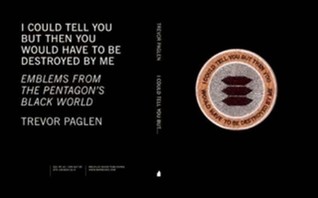
Okay, I'm about to spin wildly into critical, semi-off-topic reverie, so apologies and warnings in advance. This post is so long, I've even put in subheads. It's been a while since I've been jazzed about something new (at least to me), and I've sort of been energized by two books by Trevor Paglen (whom I learned about in the New Yorker article, "Prying Eyes," Oct. 22, 2012) . The books bear long titles and subtitles: (1) I Could Tell You But Then You Would Have To Be Destroyed By Me: Emblems from the Pentagon's Black World (2007); and Blank Spots on the Map: The Dark Geography of the Pentagon's Secret World (2009).

These titles are arguably a little misleading, or at least limiting, because the books aren't really straight-up exposés of the Pentagon. Each book is quite different, but together they focus on the culture, significance, and resonance of secrecy in American politics, warfare, law, architecture, and geography.

Military Patches

The first book, I Could Tell You..., is small, seemingly incidental, and something of a curiosity. The cover actually bears a machine-sewn, circular patch with the book's title, similar in style to the military and secret program patches featured in the book. Paglen begins with a short history of military patches -- beginning with the American Civil War -- and then discusses the contradiction of patches that call attention to programs that are secret. In part, the patches build camaraderie -- and they also serve as real warnings to other people on a particular base. A patch -- worn by members of the 22nd Military Airlift Squadron -- that says "Don't Ask! NOYFB" means just that.

The patches include a mixture of iconography, though in similar styles. Several have skeletons: the wearers bring death. Many have ghosts or cloaked figures: secrecy. Some have animals -- references to project names or Lockheed's Skunk Works. Eyes for spying and surveillance. We see a lot of Latin phrases on patches, including a convoluted passive phrase that gives the book its title. The patches are at once kitschy, mysterious, and deeply chilling. This volume serves as a nice prologue to the secret world more fully described in the second book, Blank Spots.

Uncovering the Secret World

While Paglen describes himself as an artist (a complex issue -- see discussion below), Blank Spots has few images -- just one photo at the start of each chapter. Instead, the book charts Paglen's own varied fascination with secrecy in various manifestations. The son of an Air Force doctor, Paglen grew up on and around various bases, where he occasionally encountered adults with mysterious civilian and military duties. Once, the father of a friend was dropped off at work -- at the edge of a corn field into which he disappeared.

As a graduate student in geography at UC Berkeley (my own alma mater) -- working on the siting of prisons (once urban as a warning, now rural to go unnoticed and forgotten) -- Paglen increasingly noticed that "vast swaths of land, particularly in the Nevada desert, were missing from imagery collections." Blank spots on maps are not new, we learn. In the age of exploration, maps could contain state secrets and so they were closely guarded. But Paglen is surprised to find that this phenomenon remains true today.

You can immediately see what Paglen means by visiting Google Maps or Bing Maps. Look at Nevada. You'll see blank spots in various chunks of the state, notably to the northeast of Las Vegas, where experimental aircraft are tested.

Paglen's initial interest leads him to hunker down in a hotel room in Vegas, photographing unmarked "Janet" planes (737s) that ferry ordinary-looking workers to jobs at black sites deep in the Nevada desert. He also wrangles an invitation to a celebratory dinner thrown by the Flight Test Historical Foundation at Edwards Air Force Base, where three test pilots are honored for work on recently declassified projects. Paglen discovers "blank spots" in the program -- huge pieces of the pilots' biographies are missing because they worked on projects that remain classified. As the book progresses, we find blank spots in the federal budget (arguably a violation of the Constitution), blank spots in the catalogue of satellites and debris circling the earth (space-track.org), enormous blank spots in history.

Paglen takes a step back to examine the historic rise of the modern culture of secrecy, beginning with the Manhattan Project. I offhandedly asked three educated, informed family members how many people they thought were employed by the Manhattan Project: two answered 1,000 and one said 10,000. These seem like fair guesses to me, and I might have said something similar. In fact, at its peak, the Manhattan Project employed more than 130,000 people. "It represented an industrial sector equal in size to the entire American auto industry." And yet this substantial industry remained unknown to the public, the courts, the media, and most of Congress.

The secret world grew substantially during the Cold War, except for a minimal retreat around Watergate. Its growth included legislation and court rulings, each discussed in the book. It expanded again at a terrific pace during the recent Global War on Terrorism. Today's key blank spots for Paglen are secret prisons that exist outside the law. He photographs one on the outskirts of Kabul. According to Paglen, approximately 4 million people in the U.S. hold security clearances to work on classified projects (the "black world"). By contrast, the federal government employs about 1.8 million people in what Paglen calls "the white world."

Aesthetics, Secrets, and Revelation

Blank Spots is mixture of primary and secondary history, investigative journalism, personal rumination, and more. Ultimately, Paglen has a point -- that secrecy undermines democracy and provides a foundation for the abuse of power.

But Paglen recently seems, at least partially and vaguely, to abrogate his own authority by identifying himself as an artist. And he is an artist -- by what he produces (photographs), by how he makes his living (grants and selling photos as art), and by his credentials (he has an MFA from the Art Institute of Chicago, on top of his Berkeley Ph.D. in Geography)).

In a tricky, mercurial (even secretive) stance, Paglen uses his aestheticism to step back from what might be the material impact (e.g., real-world change) of his work. For instance, in an interview in The Rumpus, Paglen casually notes that his long-distance photos of secret bases are "not produced in order to be evidence of some kind, or to reveal any kind of information at all. These are art photos." This is a statement of art for art's sake, for the value of the photos in and of themselves, as objects of beauty. I want to protest, though, that his photos are informed by a material agenda, in his words "to prevent the secret state from spreading."

But ultimately, it is worth understanding Paglen's retreat or progression toward art. Blank Spots, in its way, is a completed project, but he continues to photograph secret sites. There is something compelling -- regardless of politics -- about secrecy and revelation. The parallel existence of worlds seen and unseen, side by side, resonates; it excites the mind. It is the stuff of science fiction (think of The Matrix or "The Force"), mystery and crime fiction, the traditional and neo-gothic (think of Blue Velvet). 

From Paglen's website: "Trevor Paglen's work deliberately blurs lines between science, contemporary art, journalism, and other disciplines to construct unfamiliar, yet meticulously researched ways to see and interpret the world around us." What I find compelling here is that Paglen is charting a space in which his art exists for its own value but also simultaneously, separately, and deliberately does political (but not polemical) work.

***

As a postscript, I'd be curious to hear Paglen's take on secrecy outside government. Secret societies? Corporate and trade secrets? Arguably, the concept of the "secret" Coke formula adds value to the brand -- and then to the experience of drinking the soda. And so on.

Wednesday, November 28, 2012

Two American Books Born of Iraq


After an absence here, I am back -- but with a familiar topic: war.  I stepped away from reading war books, but a couple found me recently, and so I read them. I find this happens when the days get short.

Kevin Powers and Brian Castner both served in Iraq, Powers as an enlisted Army machine gunner and Castner as an Air Force (captain) explosive ordnance disposal (EOD) officer -- a bomb tech. Powers -- who has an MFA (and was a Michener Fellow in Poetry) has written a short, dense, harrowing, bloody novel, The Yellow Birds.  Castner, who has a degree in electrical engineering, has written a short, dense, harrowing, bloody memoir, The Long Walk: A Story of War the Life that Follows.  Together, the books make for a dismal and meaningful pair, two snapshots of warfare gone especially bad.

First, Castner.  The Long Walk is divided by alternating sections of the past and near-present time.  Castner recounts being briefed, while on duty in Saudi Arabia after 9/11, about how to turn off certain nuclear bombs that intelligence believed had been acquired by Osama bin Laden.  After the demonstration, Castner writes, "Now I knew what I wanted to be when I grew up."  His passion, it turns out, is heroic but unavoidably destructive.  For Castner, the work is physically damaging and psychically scarring.  A good deal, if not the majority, of the mental damage has physical roots -- traumatic brain injury (TBI) caused by proximity to scores (hundreds?) of explosions.

Because Castner alternates present and past, we learn about his present condition at the outset: "The first thing you should know about me is that I'm Crazy." This direct, straightforward sentence seems balanced, not crazy, but in often clinical language, Castner makes his case.  His descent begins naturally enough in Iraq.  Though full of rage and sometimes unhinged, Castner carries out his duty (after one false start), and his personal madness is masked by the madness of the war.  He vividly describes his desire to shoot mourning Iraqi women, his fascination with the hole in a dead man's head, the banality of strewn human remains.  His reactions may be crazy, but they also feel a lot like reasonable responses to unreasonable circumstances.

Back home, Castner is a well-meaning basket case.  He takes his sons to school, flies around the country as a civilian contractor (teaching bomb defusing), visits with family and friends.  He also bursts into tears at random moments, has anxiety attacks, imagines shooting people in the airport, finds no fulfillment in life.  He runs.  He runs a lot, trying to replace mental anguish with physical pain.  Yoga helps, too.

Castner arguably approaches his condition and experience like an engineer -- with structure and analysis.  By contrast, in The Yellow Birds, Powers continuously flexes his poetic capabilities.  His prose is rhythmic, sensory, adjectival.  Rivers and water and blood thread their way through the book, and the writing often has a sinuous quality.  Yet, ultimately I (first person, sensitive here to my subjectivity) found these qualities distancing my mind from the story, from the soldier's experience in Iraq.  Powers book has been very highly praises and was a finalist for the National Book Award.  It is worth reading, and at its heart, it tells a tragic story of the narrator's guilt and unraveling following the death (not a spoiler) of his comrade.  For me, though, the highly aestheticized telling of the story weakens its emotional impact.

Wednesday, September 19, 2012

Recovered -- and Refreshing -- Noir

I'm not a noir or Gold Medal Books expert, so it's hard to know if that moldering paperback with a lurid cover will be any good. You can bet on some authors -- e.g., Charles Williams -- but others haven't aged well or were never very good to start with. Fortunately, there are experts like Bill Crider and Ed Gorman, and imprints like Stark House Noir Classics.

And so, a single volume with two pretty great titles -- One is a Lonely Number (1952) by Bruce Elliott and Black Wings Has My Angel (1953) by Elliott Chaze -- found its way into my hands. Each novel tells the story of a man on the lam who falls for a dame. In its way, Lonely Number seems the more transgressive because the dame is a 14-year old with epilepsy. But antihero Larry Camonille is a nice guy who is willing to take the extra step to see that she gets the medical care she wants.

Black Wings is the longer, more romantic, introspective book. Kenneth McClure -- alias Tim Sunblade -- is smart, disciplined, and brutal. He hooks up with a mysterious, high-class call girl who likes it rough. He puts together a great heist, but this is a Noir Classic, so...

In today's era of heroes, series books, and good luck, it's refreshing as hell to read grim, nasty, feverish, morally unhinged novels of men and women who don't seem particularly destined to make it to a sequel.

Friday, August 24, 2012

The Other Jack Black Can't Win

Steven Martin's Opium Fiend led me to another great book -- You Can't Win by a different Jack Black (1871-1932). I was surprised that I hadn't heard about this book or encountered it before. It's a fun read and a detailed depiction of criminal, hobo, and prison life in the late 19th and early 20th centuries.

Originally published in 1926, You Can't Win recounts Black's life from boyhood to career criminal to prisoner and then to ex-con reformer. From about the age of 15, Black led a rail-riding, transient life and easily fell into the career of a house burglar and safe robber. Black writes a fair amount about the code among criminals, the "Johnson" family who do right by one another. Black also has pride in his craft and a work ethic of sorts. He is once terribly chagrined when an ex-robber suggests he take a straight job.

The memoir has many interesting parts that are nearly lost history. Black became a habitual opium smoker -- in part to calm the nerves that come from house burgling -- and then a sick addict. Thus the book is an important source for Martin for his opium book. It was also championed and introduced in a later edition by William S. Burroughs.

The memoir also offers several portraits of prisons, jailers, and penal systems. Black does relatively well -- and reads widely -- in a Canadian prison, but no talking is allowed at all. For calling out to a friend, Black is put on bread and water. He also describes receiving two lashings at the start and end of one prison stint; the lashings are actually part of the Canadian judge's sentence. This is one of Black's more harrowing, character-forming experiences.

Black writes very well -- he's vivid, dramatic, thoughtful, and articulate. As an extra bonus, on occasion, he discusses criminal vernacular and the sources of various underworld terms, including bum, yegg, pegged, dan, and others.

Anyone interested in the last days of the Wild West, hobo jungles, and criminal history should read this book.

Sunday, July 29, 2012

A Memoir of Addiction -- Opium Fiend

Not to be confused with comedian Steve Martin, expatriate writer (of guide book sections, mostly, apparently) Steven Martin has just published a really interesting, though at times esoteric, book, Opium Fiend: A 21st Century Slave to a 19th Century Addiction.

Martin's initial addiction is for collecting. Since he was a child, he has collected various objects with varying degrees of obsession. He ends up living in Bangkok and after giving up collecting Southeast Asian textiles, he begins to collect antique opium accoutrements -- pipes, bowls, trays, lamps, various tools, and more.

At first -- and really throughout -- Martin has the passion of a collector. But of course, he dabbles in opium smoking -- first on assignment for an article and then to learn more about the objects that he collects. For years, he smokes (or really, vaporizes) opium casually and infrequently, but eventually the drug sinks its teeth into him. Martin does a great job detailing his addiction, his isolation from social life, his attempts to quit, and the psychological aftermath of kicking (at least provisionally).

Secondarily, Martin vividly depicts parts of Bangkok as well as Vientiane (Laos). He also offers a history of opium smoking and commerce (including the Opium Wars of the 19th century). While this book is a good historical resource -- and Martin runs a consultancy advising film and TV about authentic depictions of opium smoking -- it does not discuss present-day crime and law enforcement around opium, heroin production, smuggling, etc.

Saturday, June 30, 2012

The Dead Man and the Pleasures of Limitation

Collins Ax (image from L & C Meeker)
For this post, I'm going to be more bloggy -- more ruminative -- but eventually I want to wend my way around to saying I've really enjoyed reading several titles of this pulpy, Kindle, horror-action-adventure series, The Dead Man. It's not for everybody, but it sure has its attractions...

Let me backtrack and first say, I like a good zombie movie. At their best, zombie movies have a compelling simplicity and purity. Characters fight for their lives against flesh-eating zombies. There isn't a lot of ambiguity. You can't reason with zombies, though you can outsmart them. In a semi-related way, I like a good junkie novel or movie. Again, everything is secondary (and far in the distance) to the need to fix. Characters have motivation and direction: toward the fix. In our chaotic, complex world, it's strangely refreshing to read about focus -- even when (or especially when) it's a dismal focus.

Certain genre rules provide focus and direction, too. I'd take a step back and say that confined, rhymed, highly structured poetry can be pleasing because of its constraints. I don't read much poetry, but I've seen a lot of free verse that runs too free.

So, back to The Dead Man series. Creators Lee Goldberg and William Rabkin have set up an episodic supernatural series (like an hour of television, for which The Dead Man was originally conceived). My knowledge of TV shows is thin, but The Dead Man set-up vaguely reminds me of The Fugitive. Our tall, dark, handsome, strong hero Matt Cahill is marginally on the run and he's also pursuing an evil supernatural figure, Mr. Dark (standing in, sort of, for The Fugitive's one-armed man). Matt goes from town to town (setting to setting) on his quest, and he usually hooks up with a helpful, beautiful woman.

And then there are a few supernatural rules and recurring events. Matt has survived sure death (buried in an avalanche for months) and now he can see and smell evil in people, which takes the form of festering, maggoty flesh and a terrible stench. These evil people appear normal to others, but for Matt, they are like zombies. A former mill worker and lumberjack, Matt also happens to travel with his trusty family ax. So basically, The Dead Man books -- all focused novellas of maybe 25,000 words -- have a lot of latitude but eventually dear reader is going to reach a point where there is mayhem and an ax. For now, it's working for me.

I started looking at these books with the idea of entering a contest to write a Dead Man book. Having once lived for many years in the shadow of the world's largest ax, hatchet, machete, and adze factory, I might just have an idea...

Wednesday, May 30, 2012

Return to Claude Lanzmann

A year ago yesterday, I spent ten hours in the basement of the Portland Art Museum watching the film Shoah in its entirety.  It was a character-forming experience, and I wrote a post about it ("War Crimes: the Film Shoah").  Now, a year later, I've read director Claude Lanzmann's memoir, The Patagonian Hare, which is a good accompaniment to Shoah -- and interesting even without the anchor of his great film.

Lanzmann, it turns out (and I guess I would know this if I were French), had a visible, significant, exciting existence even before Shoah -- and he is a passionate, though occasionally digressive, storyteller. Born in 1925, Lanzmann was raised (along with two younger siblings) primarily by his father, after his mother quit the marriage and family.  (Lanzmann reconciles with her and adores his stepfather.)  The Lanzmanns were non-practicing Jews -- and Lanzmann recounts that his first encounter with a rabbi only took place in the 1950s.

But wait... After seeing Shoah, one wouldn't expect Lanzmann to proceed in a traditional fashion -- and he doesn't.  The memoir actually begins: "The guillotine -- more generally, capital punishment and the various methods of meting out death -- has been the abiding obsession of my life."  Lanzmann then launches into an overwhelming ten-page reverie describing execution after execution -- by guillotine, by garotte, by axe, by a bullet to the neck, by bayonet training on live human targets.  Then Lanzmann catches his breath and writes, "You must understand that I love life madly, love it all the more now that I am close to leaving it..."

And so his life proceeds -- death and life, death and life, death and life.  Lanzmann and his family evaded deportation and fought in the French Resistance.  He went on to be a journalist and right-hand man to Jean-Paul Sartre (at the journal Les Temps modernes); he was Simone de Beauvoir's lover for many years (and they keep getting into dramatic, life-threatening mountaineering incidents); he first traveled to Israel in the early 1950s -- and to North Korea as well.  He tells a long, very French story about his passion for a Korean nurse -- and the utter weirdness and severity of North Korea.  Lanzmann supported Algerian independence and marched with rebels, but he later repudiated the new nation when it supported the destruction of Israel.

Lanzmann stumbled into film-making, first making a film called, Pourquoi Israel, after doing some French TV work.  He agreed to make a then-untitled Holocaust film for the simple reason that he wanted to spend time in Israel with a woman who became his wife.

The last 20 percent or so of the book (about 100 pages) then describes, in almost an abbreviated way, the making (and to a lesser extent, reception) of Shoah, which took 12 years.  Lanzmann describes how he met people and conceived of some of the segments -- such as the scene with Abraham Bomba, pretending to cut hair in a Tel Aviv barber shop, as he describes cutting the hair of women moments before they were gassed at Treblinka.  He also discusses segments and people who didn't make it into the film -- including a member of the Einsatzgruppen.

In one moving scene, Lanzmann describes knocking late at night on the door of an elderly man in a small Polish village -- this is Henrik Gawkowski, the engine driver of the death trains at Treblinka, who appears early in the film.  Lanzmann is the first man to ever ask him about his experiences, and he welcomes and feeds Lanzmann, and they talk until dawn.  Henrik (as Lanzmann affectionately calls him) is "devastatingly honest," and this scene deepens one's experience of the film.

On many occasions, Lanzmann lied to government and private funders in order to see his film to its 9.5-hour, 12-year end.  But while seeking funds in the U.S., he could not answer one question: "'Mr Lanzmann, what is your message?' Each time, I remained silent, I was incapable of answering such a question; I still am.  I don't know what the 'message' of Shoah is.  I never thought of it in those terms.  If I had said, 'My message is: Never again!' or perhaps 'Love one another,' wallets would probably have sprung open, but I was a sorry fundraiser: of the budget for Shoah, not one single dollar came from the USA."

Tuesday, April 17, 2012

Time Travel : My 1995 Review of Hard-Boiled: An Anthology of American Crime Stories

I've fallen down on the job -- again. In order to assure my few readers that I am slothful, not dead, I thought I'd make a quasi-reappearance with a reprint of my review of Hard-Boiled: An Anthology of American Crime Stories, edited by Bill Pronzini and Jack Adrian. First, a short explanation...

A month or so ago, while searching for something else on the Web, I found a bibliographic reference to a review of mine that ran in the academic journal Studies in Short Fiction in the Fall 1997 issue (it ran two years after I wrote it). I remember writing the review but was under the impression that it never ran -- that it had fallen through the cracks of the editor's desk. Apparently it did run, and the text is available online (in CBS's FindArticles database). When I wrote it, I had been reading some -- but not a lot of -- crime fiction. So, like a good junior academic, I sort of feigned greater expertise than I had. I was eager to have some sort of publication in an academic journal -- if only to show that I was trying (it didn't do any good). Previously, I had published (and been paid for) a few general reviews that ran in The Daily Californian in Berkeley. Anyway, here's the review; please forgive my pretensions...

HARD-BOILED: AN ANTHOLOGY OF AMERICAN CRIME STORIES, edited by Bill Pronzini and Jack Adrian. New York: Oxford University Press, 1995. vii 532 pages. $25.

This collection serves as a reminder that some of the strongest American writing of the twentieth century has appeared in the genre of the hard-boiled. It also demonstrates the range of the genre and the problems with identifying criteria that make a story truly hard-boiled.

With academic and general interest in American crime fiction continuing to mount, Hard-Boiled provides a selection of twentieth-century stories by decade from the twenties to the nineties. The best stories come from the twenties, thirties, and, in what may be a surprise to many readers, the fifties. The stories of the first decades are identifiably fueled by prohibition, depression, and gangsterism. The stories from the fifties illuminate the strong undercurrent of anomie, misogyny, and racism that colored the predominant cultural picture of postwar middle-class prosperity.

Many of the usual suspects appear in this anthology: Dashiell Hammett, Raymond Chandler, Chester Himes, two Cains (Paul and James M.), two MacDonalds (John D. and Ross), Mickey Spillane, Evan Hunter, and Jim Thompson. Editors Bill Pronzini and Jack Adrian have also searched for new and lost voices, as well as unexpected stories by writers now well known in the field. Of the latter, the best find is a story called "Trouble-Chaser" by Paul Cain, one of the hardest of the hard. Cain's only novel, Fast One, and his story collection, Seven Slayers, are minor classics, both recently reissued; "Trouble-Chaser," on the other hand, has not seen the light of day since its 1934 appearance in the seminal pulp, Black Mask. A Hollywood story, "Trouble-Chaser" compresses some of the genre's best elements into fewer than 20 pages: a booze runner, his hooking wife, a Hollywood studio head, his heroin-addicted, jealousy-stricken starlet wife, and a trouble-chasing, on-the-make hero whose wit matches his cynicism. The story accumulates three bodies, showcases two staged suicides, and ends tightly with a nice nod to the reader: our hero curls up with a book as he waits for the police to arrive.

Cain's story exemplifies with the strongest of the collection that the hard-boiled is at its peak when it is pitiless, plotted at breakneck speed, a touch droll, and well aware of its generic confinement to amoral entertainment. With the exception of Gil Brewer's grim, sketchy story, "Home" (1956), about a black man run down by a car, the stories driven by social issues fall flat. A case in point, Lawrence Block's 1990 story, "Batman's Helpers," follows Block's detective, Matthew Scudder, and his compatriots as they hassle immigrants hawking unlicensed Batman togs on the streets of Manhattan. The story ends with Scudder leaving the easy assignment after a day--a hard-boiled man with no stomach for leaning on the disenfranchised.

Strangely enough, Block's oddly saccharine story made its original appearance in Playboy. This late venue for the hard-boiled story stands as a reminder of the genre's targeted male audience, a fact most evident in the name of the genre's main vehicle of the fifties: Manhunt. The stories of Manhunt can be exceptionally brutal. David Alexander's "Mama's Boy" (1955), for instance, follows a narcissistic bodybuilding gigolo as he searches for, finds, and kills an older woman. Hard-Boiled's editors should be applauded for including this story, which displays the seaminess of the genre's best writing.

In spite of all my boy talk, two women wrote and published some of the finest stories in the 1950s men's magazines. Helen Nielsen does a fine job in "A Piece of Ground" (1957), a stark, almost archetypal rendering of the rustic undone in the big city. Leigh Brackett also appears with a story that is stronger than its title, "So Pale, So Cold, So Fair" (1957). Brackett's place in this anthology also draws the link between the hard-boiled and film noir: she co-authored the screenplay for Howard Hawks's adaptation of Raymond Chandler's The Big Sleep (1946) and nearly 30 years later scripted Robert Altman's version of Chandler's The Long Goodbye (1973).

Pronzini and Adrian's introduction provides a good thumbnail sketch of the genre's history. They do better discussing publishing history than literary genealogy. Tying the hard-boiled hero to Huck Finn, Ahab, and Natty Bumppo only goes so far. They also rightly confess the collection's limitations, and indeed several strong hard-boiled authors are absent. Nevertheless, the collection serves as both a useful introduction to and distillation of the hard-boiled.

Sunday, February 26, 2012

Reading Reflections on the Kindle, Four Months In

I've been reading a fair amount -- but putting up notices on Goodreads rather than fuller write-ups on this blog. I've also been reading a lot about ebooks and ereaders -- manic and apocalyptic (e.g., Franzen), and I thought I would weigh in with my own personal experience as a reader and book buyer over the last four months (I bought my low-end $79 Kindle in October 2011).

First, a little context: I am not a book collector, but I own a lot of books. I have liked to surround myself with my books as, I suppose, a physical marker of my experience reading them. I do donate and sell some books (e.g., to Powell's) and I use the library, but I also keep books that I'll never read again. They take up space, and I've moved books several times. Next time I move, I plan to cull my collection. I like the book as physical object, and perhaps partially in response to the emergence of electronic text, I wrote about the cultural and social meaning of books and print in early and 19th-century American culture in a doctoral dissertation completed in 1997. That said, I'm not overly sentimental about books (and less so in recent years), nor excessively enamored of or repelled by technology per se. Okay, that's the context.

Since purchasing my Kindle, I have read 13 books in full, of which 2 were read on the Kindle: Charles Bukowki's Ham on Rye ($1.99 special) and George Pelecanos's What It Was (new book, 99 cents special). I have also read stories from several collections, including West Coast Crime Wave and Patti's Abbott's Monkey Justice. (I actually bought the Kindle so I could read WCCW, where a story of mine appears.)

I also started reading several novels -- and have left them unfinished at a much greater rate than I abandon print books. I also wouldn't say that I've abandoned these books -- I may dip back into them at any time, though with loss of continuity. I have also purchased many more ebooks than I am going to read. They don't take up space, and they are cheap; they are almost bought defensively so that I don't kick myself for not jumping on them when I had the chance. I've bought crime novels by McBain, Block, Disher, and others, usually for $1.99. I've downloaded a few books for free and never paid more than $2.99 or $3.99.

Generally, I continue to read from the printed page. That said, I read Ham on Rye and What It Was quickly on the Kindle, mostly at home, and stuck with them because they were particularly good books. I went on to read print editions (borrowed from a neighbor) of two other Bukowski titles. I guess the bar is higher for me to get through a book on Kindle.

Here is a counter-example of sorts. I recently read (in print, from the library) Paul Barrett's non-fiction book, Glock: The Rise of the American Handgun. This was a good book, but not a great book. I could see myself forgetting about it on the Kindle, but its insistent presence in my house (with a cover picture of a Glock) kept me at it. I haven't dipped into Kindle Singles or novellas -- but I like the idea of a shorter long format. Glock would probably be fine as a 30,000-word ebook -- longer than a long article but not puffed out to book length.

My Kindle has also been valuable for travel and short reading breaks while running errands. Recently, I stood in an hour line at Disneyland -- and I read McBain on the Kindle to pass the time. The Kindle is small and seems sturdy; I often carry it in a coat pocket without a Kindle cover.

So, that's my middle-of-the-road take on the Kindle as a reader. If I were a publisher or were opining in my semi-capacity as a commercial genre fiction writer, my take might be a bit different. If I were writing as a citizen-consumer concerned about competition-antitrust, I would certainly raise some red flags about Amazon (and probably Google). I don't like that I've aligned myself so closely with Amazon -- but I don't have strong allegiance to Big Six publishers either. My views and experiences are sure to evolve, and maybe I'll report back. Onward...

Sunday, January 22, 2012

War Reading Culminates with Inferno: The World at War, 1939-1945

The pattern isn't quite entirely clear, but it seems to me that in the winter months (and into spring) in the Northwest, I turn to reading about war. I've mostly read Vietnam War books. I've also read some big, fat epic war books in the last few years: The Naked and the Dead, Matterhorn, The Kindly Ones, The Thin Red Line (all, notably, novels). On May 29, 2011, I saw all of the Holocaust documentary, Shoah, in one day (9+ hours), at the basement/bunker auditorium in the Portland Art Museum.

For all this immersion in war -- mostly novels and memoirs -- I had never read a straight-up, big picture history of World War II. I had thought about it but hadn't tackled the matter. Then, last November, I skimmed the New York Times glowing review of Inferno: The World at War, 1939-1945 by Max Hastings, and I thought this might be the book -- and I was right. Inferno is a mind-bending, fluid, deeply thoughtful and compassionate book. It should be required reading for somebody -- maybe candidates for high office.

Inferno is comprehensive to a degree, covering major inflection points of a very complex war. It is not exactly a precise military or political history. Instead, Hastings uses a huge amount of source material from everyday people -- a housewife in Germany, infantry soldiers, pilots, and so on. At the same time, Hastings discusses key civil and military leaders and their strengths and faults. Hastings also only superficially covers topics that are well covered elsewhere. He discusses the Holocaust only a bit, and while he writes extensively about the Allied bombing of Europe, he does not discuss Dresden in detail.

But bypassing a discussion of Dresden does not mean that Hastings avoids tough questions about the conduct of the war. He looks at a range of controversial topics -- the European bombing campaign, dropping the atom bombs -- and offers his views in a measured way that reflects deep historical knowledge. Through this analysis, the book helps provide some grasp on what cannot today be entirely conceived or processed. Hastings also corrects misinformation and helps readers (at least this American reader) better understand the roles of each nation and the context in which they went to war.

The original, UK version of Inferno was called All Hell Let Loose. It might as well just be called Fucking Madness. The amount of death and destruction is incomprehensible -- especially when set against other wars. Civilians and soldiers in Russia died in the tens of millions. More people died in Leningrad (with maybe 800,000 starving) than all of U.S. and British combat deaths combined. You can open Inferno on any page and find a startling statistic or story. The Manhattan Project cost $3 billion, but the B-29 Superfortress program cost $4 billion. The same day that the bomb was dropped on Nagasaki, the Russians attacked Japan through Manchuria. That action alone -- two weeks of battle as the war wrapped up -- resulted in the deaths of 92,000 soldiers. And on it goes for 650 pages.

The wake of World War II still ripples today, and this book directly and more often indirectly touches on that matter. A number of military and strategic points were made clear by the war, and these points should help guide policies today to some extent. Investment in the technologies of destruction were critical to the Allied effort, but weapons once built are usually ultimately used (as Hastings notes again and again). As a culture (and a society under totalitarian state duress), the Russians accepted a casualty rate far higher than the western democracies. To engage in large-scale mobilization and combat, the people of a democratic nation must believe that its quality of life could be so diminished without response, that the violent death of tens or hundreds of thousands or millions is a worthwhile price to alleviate that threat.

Anyways, if you have any interest in war or World War II, read this book. It has received high praise from many reviewers -- and that praise is more than warranted.

Thursday, December 15, 2011

My Name Under Alfred Hitchcock's Photo

Today, I received my subscriber's (as opposed to author's) March 2012 copy of Alfred Hitchcock's Mystery Magazine (and by the way, the publication vacillates about that possessive apostrophe; it's easier to just write AHMM), and my latest story, "Sheltered Assets" is included. This is my first story in AHMM, though I have had two in the sister publication, Ellery Queen's Mystery Magazine.

Of course, rush out and get the magazine (or subscribe to it). The best place to find the print magazine used to be, alas, Border's. Now you have to find it elsewhere -- or buy it digitally. (As I understand, AHMM and EQMM are doing well with digital sales, and both magazines are starting to offer ebook collections.)

A few words about the story: it's my first published story to be set in New York City. I've written a couple of other New York stories, but they remain unpublished. I'm glad to have the chance to mine, vaguely, my year living in New York. This story also has a woman protagonist, a matronly society woman, who volunteers at an animal shelter. My previously published story, "Bridget's Conception" (in West Coast Crime Wave), also has a woman protagonist (a young, expecting mother). I don't want to give anything away, but I guess I should say that I just look at the world and think, women should be committing more crimes. The story has the economic crisis as its backdrop, and I'm especially proud of the title itself, "Sheltered Assets," which I hope resonates in several directions.

When I launched this blog (when my first EQMM story was published), I thought I would write more about my writing and the process, and I haven't done that, except to make a few publication announcements. I'd rather write about other people's books (and movies) in my legacy and phantom role of "critic." I don't have a lot of (or any) writing or publishing advice that can't be found elsewhere. But since I'm in a reflective and self-promotional mode, I'll give a short update: My first novel, Jailhouse Pale, remains unpublished. My agent received a fair number of kind rejections (and I felt like I got a fair reading from several notable editors), and he is planning to send it a few more places. I am now about half-way through writing a second novel, with the same heister protagonist. The new book has more complexity and higher stakes than the first, and I hope to finish it some time next spring or thereabouts. And after that, I've threatened to work on my drawing and painting instead.

Thursday, November 3, 2011

Fun Bleak Fun: Scott Phillips's The Adjustment

Scott Phillips's new novel The Adjustment is really too new to be an entry in Friday's Forgotten Books, but this post is meant to be a preemptive strike: this novel shouldn't be forgotten or missed.

Phillips returns to his native ground of Wichita, Kansas, in this violent, amoral, darkly funny yarn of ex-serviceman Wayne Ogden's return to civilian life after World War II (that's "the adjustment" of the title). Wayne, however, had a somewhat non-traditional tour of duty in England and Italy, where he focused on pimping and black marketeering. He's quite proud of (and nostalgic about) his wartime activities:

"If you are a reasonably competent and ambitious individual with a bit of initiative and creativity, and a willingness to look at strict regulations as loose guidelines to be skirted when necessary or convenient, there is no better job for you than Master Sergeant in the United States Army Quartermaster Corps"; "The QM Corps gave me thrilling and lucrative work. Men needed the things I offered for sale. Women, some of them beautiful women, relied on my for protection and income, and the army relied on me to distribute whatever I wasn’t able to reroute and sell elsewhere. It was a good life, and by the time it came to its violent end I could see my sweet situation beginning to unravel."

Wayne maintains this wonderfully blithe tone throughout the book -- even when he is committing atrocious acts. Indeed, he seems reminiscent of some of Charles Willeford's great "blithe psychopaths" -- entrepreneurial (and thereby wholly American), funny, seemingly well-intentioned, and smarter than everyone else in the book.

Back in Wichita, Wayne becomes bored with his corporate job at Collins Aircraft as "a bag man and babysitter for an alcoholic skirtchaser" (the company boss, Everett Collins). He's also bored with domestic life and fears his impending fatherhood. Hi-jinx ensue, to say the least.

Interestingly, this book was published by a relatively small press, Counterpoint, which inevitably makes the book easier to miss. Phillips's first novel, The Ice Harvest (great stuff), had a Big Six publisher and was adapted into a so-so, too Hollywoody film. The Adjustment is a fine novel, but maybe its lack of moral compass and distasteful protagonist made it too commercially risky. Who knows, but I'm hoping this book reaches the audience who will dig it.

Thursday, October 20, 2011

West Coast Crime Wave


I'm back and harried. I'll say more about West Coast Crime Wave later. For now, I'll just note that the e-book is out and available (now on Amazon and soon at other e-book outlets). The book features stories set in west coast locations written by west coast authors. I'm the Portland guy. As part of the promo, the publisher is highlighting different authors on its website. Today is my turn. The interview can be found at this link.

Friday, September 9, 2011

Death and Heroin in a Nameless City: The Scene

A Friday's Forgotten Book entry: A friend recently thrust a book into my hands -- The Scene by Clarence L. Cooper, Jr. -- and said that he had bought it as a naïve, suburban youth at a garage sale for 10 cents or a quarter. It had shocked and appalled him -- and he thought I might like it. He was right.

The Scene is something of a social/realist (or even naturalist) novel, masquerading (or, I suppose, passing) as a crime novel. The back jacket copy provides a pretty accurate synopsis: “This explosive novel sweeps bare the festering jungle of addicts, pushers, stoolies, prostitutes, pimps, killers, and cops-on-the-take to reveal that murky half-world of narcotics known as THE SCENE.” It also includes some honest cops, leaning on street dealers for a big arrest, as well as a nice, relatively clean-cut girl (who falls in love with a junkie).

The crime/policing plot keeps the story moving along, but the book is largely made up of snapshots of users, dealers, boosters, and so on. The nice, respectable people are a little flat as characters, whereas the junkies are harrowing and vivid. Several scenes depict characters who are “bogue” (there is a glossary in the back), which here means sick (or getting sick) from withdrawal. Check out, Rudy Black, who has a heavy habit, suffering from withdrawal in his jail cell: “He lay groveling on the floor, his body jerking uncontrollably, his eyes twitching, his mouth yawning until the bones in his face felt as though they were slowly breaking, the mess from his nose streaking and drying on his face in tight, slick bands. He crawled over to the toiled and threw up blood in it.”

And it gets worse. I don’t think I’ve read a book with so much vomiting -- from withdrawal and after shooting up.

Cooper wrote a handful of other novels, several of which were reprinted by Old School Books. The Scene was published by Crown (Random House) in 1960; his subsequent books came out (mostly, I think) from pulp publisher Regency House. Wikipedia tells me that Cooper -- writer, ex-con, junkie -- died in 1978 at age 43 or 44. I’m going to keep an eye out for some of his other books.

Thursday, August 11, 2011

Joe Gores's Dead Skip: Bay Area History and the Missing Parker Scene

Back to crime fiction (and a wannabe Friday's Forgotten Books entry, a day early). Joe Gores -- crime fiction writer, Edgar winner, Hammett aficionado -- died earlier this year, and I had never read any of his books. I started with his first DKA series book, Dead Skip (1972). DKA stands for Dan Kearny Associates -- a PI agency that repos cars.

At the outset, one of the repo men Bart Heslip gets clocked and put in a coma, and his buddy Larry Ballard investigates. It's a straightforward, procedural-oriented book -- with Ballard chasing down leads, following clues, pounding the pavement, and solving some riddles, along with his boss, the gruff Dan Kearny and his fetching colleague Giselle Marc.

I enjoyed the book, but it really shone in two (subjective) areas for me. First, the book is a great time piece of the San Francisco-Bay Area in the early 70s. We see seedy and fancy parts of San Francisco, and then the book rotates out to the East Bay -- my old stomping grounds. Ballard ends up in the dumpy burbs/burgs of Concord and Martinez, complete with a visit to the decrepit Contra Costa County jail. (I visited this jail a couple of times in the 1980s, but it was a newer version.) We also see a neighborhood gutted and gouged for construction of BART (Bay Area Rapid Transit), which began service in 1972.

I had this same experience of regional familiarity when reading Plunder Squad, one of the late first-phase Parker heist novels by Donald Westlake (writing as Richard Stark); Parker ends up in Concord and the Oakland hills. In one Dead Skip scene, Kearny knocks on a door -- and a big, mean man comes out to talk with him. Sure enough, it's Parker, set into this book. Gores does a great job capturing Parker's authority and expertise. It's a little gimmicky -- but really works. I felt like I had unexpectedly run into an old friend (a killer and heister, albeit) and found a lost bit of a favorite character.